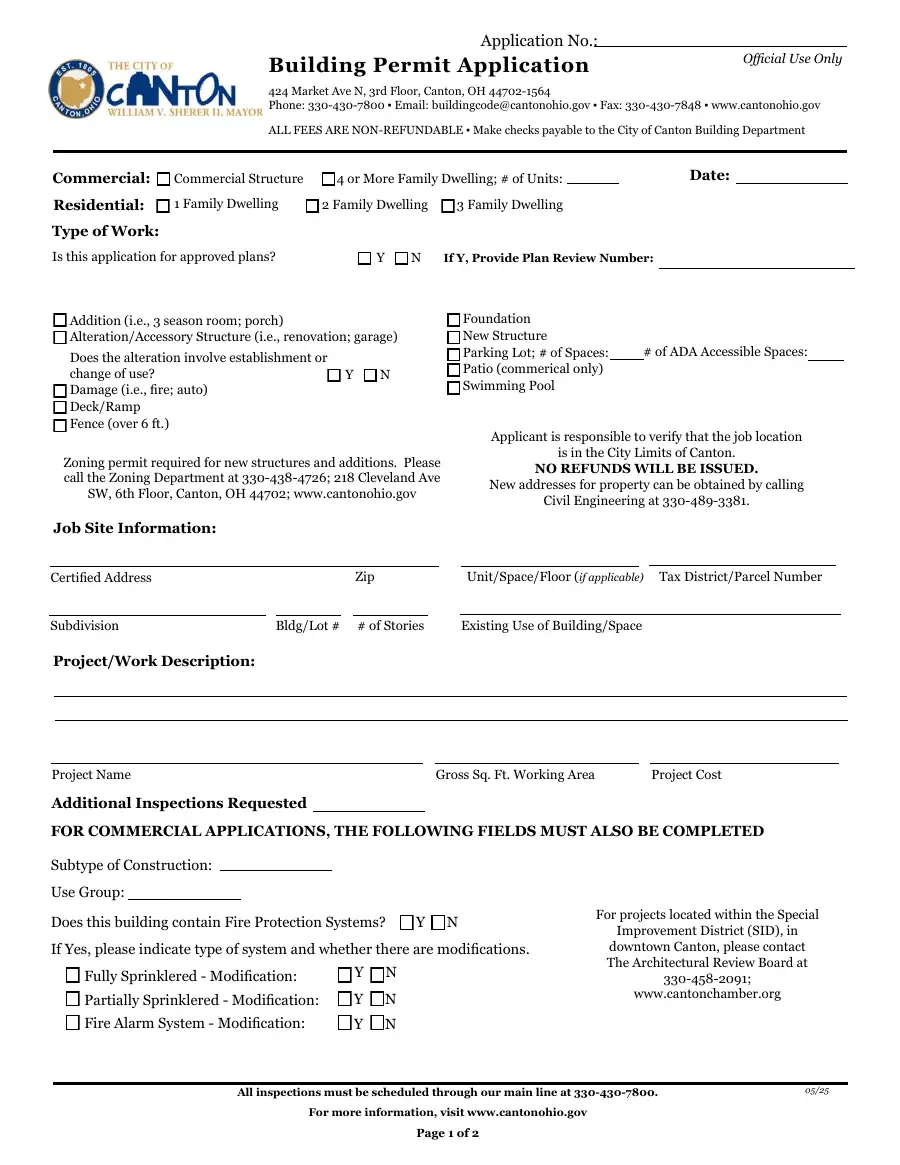
Canton's own permit form, filled in for you, $49.99: answer the quiz and we type your answers onto the city's form.
★★★★★ 4.8 from 6 customer reviews: “In a world of ever-increasing slop, it's nice to have a tool that cuts through all the low-quality sites, promoted on regular search engines, to get to the actual government forms.” (Kollin P.) “I got exactly what I needed in less than a minute, hassle free and painless” (Michael W.) All reviews
Prefer to file it yourself? The $24.99 Filing Kit gives you the answer for your address, what Canton needs from you and step-by-step instructions. Check my Canton address →
Canton's own permit form, filled in for you, $49.99: answer the quiz and we type your answers onto the city's form.
Prefer to file it yourself? The $24.99 Filing Kit gives you the answer for your address, what Canton needs from you and step-by-step instructions. Check my Canton address →
Canton Building Department contact
City of Canton Building Department
For the phone number and current details, see the city's official website.
Ohio context for Canton permits
Ohio adopted the 2020 International Building Code as the basis for its Ohio Building Code, with state amendments. Canton enforces this state code plus local ordinances. One key difference: Ohio allows owner-builders to permit and build work on owner-occupied single-family homes without hiring a licensed general contractor. That applies to decks, additions, garages, and other structural work — but electrical work must still be done by a licensed electrician, and plumbing inspections must be signed off by a licensed plumber (though the homeowner can do some plumbing if permitted). This flexibility is broader than many states allow, but it doesn't mean inspections are lighter — Canton uses the same inspection standards as any contractor-built project.
Ohio's electrical code is the 2020 National Electrical Code with state amendments. Electrical work is tightly regulated: homeowners cannot pull electrical permits themselves, even as owner-builders. A licensed electrician (journeyman or master) must pull the permit, do the work, and pass the inspection. If you want to do electrical work yourself, you'll need to hire someone licensed to pull the permit and manage inspections.
Frost depth in Ohio varies regionally. Canton's 32-inch frost line is typical for northern Ohio; it's shallower than Minnesota or Wisconsin but deeper than southern states. Structures must be built below frost to avoid settling and frost heave. This is enforced consistently at inspection and is non-negotiable.
Common questions
Do I need a permit for a small shed or storage building?
Most likely yes. Canton requires a permit for detached structures over 200 square feet. Even smaller sheds may need a permit if they include electrical service, a foundation that requires footings below the 32-inch frost line, or if local zoning rules apply. A quick call to the Building Department before you build saves a lot of grief. If you're building on a concrete pad with no electrical, you might get a 'no permit required' answer — but confirm first.
Can I pull a permit for electrical work myself?
No. Ohio law requires a licensed electrician (journeyman or master) to pull the electrical permit and perform the work. Even if you're doing the other work on your house yourself as the owner-builder, you must hire a licensed electrician for any permanent electrical installation. The electrician pulls the permit, does the work, and manages the inspections. You can do other trades yourself, but electrical is off-limits for homeowners.
How deep do deck footings need to go in Canton?
At least 32 inches below grade (below the frost line). Some jurisdictions add a safety margin and require 36 or 40 inches. The safest approach: dig to 32 inches, then go another 4-6 inches deeper to be sure. Frost heave happens when water freezes under a footing that doesn't go deep enough, pushing it up and cracking or shifting the structure. Canton's inspectors check footing depth, so this isn't optional — it's part of the inspection process.
What's the typical permit fee and how long does it take?
Residential permits in Canton typically cost $75–$300 depending on project scope and estimated value. Decks and fences run $150–$300. Roof replacements run $100–$250. Additions and remodels run $300–$1,000+. Over-the-counter permits (decks, fences, roof) often get same-day or next-day approval. Plan review for larger projects takes 2-4 weeks. Inspections are scheduled after filing and usually happen within 5-10 business days depending on inspector availability.
Do I need a site plan and drawings for my permit?
For smaller projects like decks and fences, a simple sketch showing the location on your lot and basic dimensions usually works. The Building Department can tell you what they need when you file. For additions, remodels, and larger structures, yes — you'll need proper floor plans, elevations, and a site plan showing setbacks from property lines. Many homeowners have these drawn up by a contractor or designer anyway; if you're building something substantial, invest in a plan. It reduces rejections and speeds plan review.
Can I file a permit online in Canton?
As of this writing, Canton does not offer online filing for residential building permits. You file in person at City Hall during business hours (typically Mon-Fri 8 AM - 5 PM). Bring the completed application, site plan or sketch, any floor plans, and your payment. The department may offer online lookup for submitted permits; check Canton.gov or call to confirm current options. Some jurisdictions are moving to online filing — check the Building Department website to see if that's changed.
What's the difference between a variance and a conditional-use permit?
A variance asks the zoning board to waive a rule (like setback distance or lot coverage). A conditional-use permit allows a use that's not normally allowed in your zone, but only under specific conditions. Most residential permit applications don't need either. But if your deck doesn't fit the required setback, or your addition would exceed lot coverage, you might need a variance. That adds 4-8 weeks to the timeline and costs $200–$500+. Always check setbacks and lot coverage before you design — it's cheaper than redesigning after the fact.
What happens if I build without a permit?
Canton building inspectors and code enforcers respond to complaints and perform routine compliance checks. If unpermitted work is discovered, you'll be ordered to stop work, bring it into compliance, or remove it entirely. That usually means retroactive permits, additional inspections, and fines. On top of that, unpermitted work can be flagged when you sell your house, killing deals or requiring expensive remediation. If you're found doing unpermitted electrical work, that's a safety violation and can bring harsher penalties. The permit fee upfront is always cheaper than the cost of fixing unpermitted work later.
Do I need to hire a general contractor?
No, not for owner-occupied single-family homes. Ohio allows owner-builders to pull permits and do the work themselves. But there are strings: the house must be your primary residence, you must pull the permit in your name, and you must do the work (or hire licensed trades like electricians and plumbers). You can hire subcontractors for specific trades — that's normal. But you can't hire a general contractor to pull the permit and manage the project on your behalf unless they're licensed. That said, many homeowners hire contractors anyway because they have expertise, insurance, and accountability. It's legal to DIY; it's not required.
Ready to start your Canton project?
Pick your project type from the list above, or search the site for the specific work you're planning. Each project page explains what triggers a permit, what you'll need to file, what the inspection process looks like, and the most common mistakes that slow things down. If your question isn't answered, the Building Department phone number and address are above — a quick call before you start is always the right move.
More Ohio towns
Towns near Canton in the alphabet where we file your permit for you: Boardman, Brooklyn Heights, Brunswick, Butler County, Chardon, Cincinnati, Cleveland, Colerain.