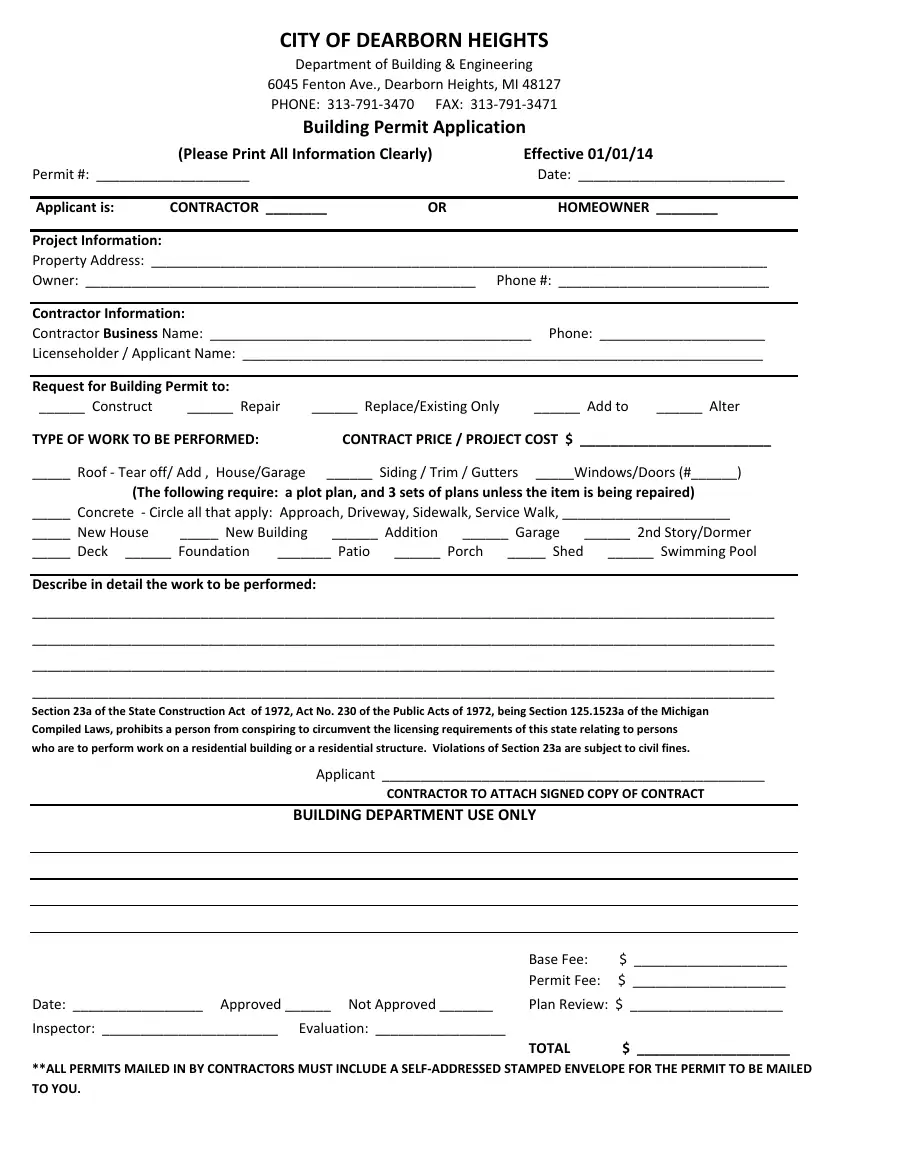
Dearborn Heights's own permit form, filled in for you, $49.99: answer the quiz and we type your answers onto the city's form.
★★★★★ 4.8 from 6 customer reviews: “In a world of ever-increasing slop, it's nice to have a tool that cuts through all the low-quality sites, promoted on regular search engines, to get to the actual government forms.” (Kollin P.) “I got exactly what I needed in less than a minute, hassle free and painless” (Michael W.) All reviews
Prefer to file it yourself? The $24.99 Filing Kit gives you the answer for your address, what Dearborn Heights needs from you and step-by-step instructions. Check my Dearborn Heights address →
Do I need a permit in Dearborn Heights, MI?
Dearborn Heights sits in both climate zones 5A and 6A, split roughly north-south across the city. That matters for foundation depth: your frost line is 42 inches — which means deck posts, pool barriers, and garage additions all need footings that bottom out below 42 inches, per Michigan's adoption of the 2015 IBC with state amendments. The city's Building Department processes permits through a mix of over-the-counter and plan-review submissions. Most residential permits move quickly if filed correctly the first time; rejections almost always come from incomplete site plans (missing property lines, setback dimensions, or soil-bearing calculations for footings). Owner-occupied properties can use owner-builder permits for work you do yourself, but you still pull the permit before starting — not after. The online permit portal exists but requires a phone call to the city to access or confirm your property ID. This page walks you through the most common Dearborn Heights projects, what triggers a permit, and what the Building Department actually cares about.
What's specific to Dearborn Heights permits
Dearborn Heights adopted the 2015 International Building Code with Michigan amendments, which means you're working to that edition statewide — no local flavor on major structural rules. The 42-inch frost depth is strict: deck footings, foundation walls, and pool barriers all must penetrate below 42 inches. If you're in the sandy-soil north section of the city, your building inspector may ask for a soil-bearing report (common for decks or additions on sand — glacial till down south is more predictable). Don't skip this upfront; a footing inspection rejection in October costs weeks of rework.
The online permit portal is available, but most homeowners still file in person or by phone. Call the Building Department to confirm your property ID and submission method before you prep documents. The city processes routine permits (fences, small decks, water-heater swaps) over-the-counter in 2-3 business days if everything is complete. Major projects (two-story additions, pools, new garages) go to plan review and typically take 3-4 weeks. The common rejection for Dearborn Heights: incomplete site plans. You need property lines, setback dimensions (your lot boundary to your proposed structure), and footing depth noted in writing — not just guessed.
Permit fees in Dearborn Heights follow the state model: a base filing fee plus a percentage of estimated project value. Deck permits typically run $100–$250 depending on square footage and complexity. Fence permits are flat-fee (usually $50–$75). Additions and pools are assessed at 1.5–2% of project valuation — so a $50,000 addition might carry a $750–$1,000 permit fee. Plan-review expediting is sometimes available; ask when you call.
The Building Department inspects at key points: footing (before you pour concrete), framing (before drywall or siding), and final (before you occupy or close the project). For deck work, you'll typically get a footing inspection and a framing inspection. For additions and major projects, you'll also get rough-in inspections for plumbing, electrical, and HVAC if those trades are involved. Inspections are usually scheduled within 1-2 business days of your request.
Owner-builder permits are allowed for owner-occupied residential work in Michigan. You pull the permit yourself (no licensed contractor required), but the work must be at your primary residence and you can't pull more than a certain number of permits per year statewide (typically 1-2). If you sell the house within a year of project completion, you may need to disclose owner-builder work to the buyer — and some lenders won't finance a home with recent owner-builder permits. Hire a licensed contractor if you have doubt; the permit fee savings ($200–$500) isn't worth a financing or sale problem later.
Most common Dearborn Heights permit projects
These are the projects that trigger the most permit questions in Dearborn Heights. Each has local quirks — frost depth, setback rules, or inspection timing — that can slow you down if you miss them upfront.
Decks
Decks over 200 square feet or elevated more than 30 inches require permits. Your 42-inch frost depth means deck posts must penetrate below 42 inches — no shallow footings. Most Dearborn Heights decks get a footing inspection and a framing inspection.
Fences
Fences over 6 feet in side or rear yards typically need permits. Front-yard fences over 4 feet require variance review. Pool barriers always need a permit regardless of height. Flat fee, simple filing.
Roof replacement
Most reroofs in Dearborn Heights don't require permits if you're not changing the roof structure or height. Full roof replacement (shingles, underlayment, flashing) is usually permit-exempt. New roof structure (trusses, framing) requires a permit.
Room additions
Any addition or detached/attached garage over 200 square feet requires permits, electrical permits, and usually plumbing. Plan review averages 3-4 weeks. Footing depth (42 inches) and setback compliance are the usual sticking points.
Dearborn Heights Building Department contact
City of Dearborn Heights Building Department
Monday–Friday, 8 AM–5 PM
For the phone number and current details, see the city's official website.
Michigan context for Dearborn Heights permits
Michigan adopted the 2015 International Building Code (IBC) with state amendments. This edition is enforced statewide, so your frost depth, setback rules, and structural requirements are set by state code, not local quirks. The Michigan Energy Code (based on IECC 2015) requires insulation, window ratings, and HVAC efficiency standards. Dearborn Heights, like all Michigan municipalities, must enforce these minimums at minimum. The state allows owner-builder permits for owner-occupied residential work — you pull the permit yourself, no licensed contractor required — but disclosure rules apply if you sell the house within one year. Michigan also recognizes licensed builders and contractors (through the Michigan Construction Lien Act and licensing boards); if you hire a contractor, verify their license status. The state does not pre-approve online portals; individual cities set their own systems. Dearborn Heights' Building Department maintains a portal but recommends phone calls or in-person filing for clarity. Deed restrictions, HOA rules, and historic-district overlays may add extra layers — check your deed and neighborhood rules before pulling a permit.
Common questions
What's the frost depth in Dearborn Heights and why does it matter?
Dearborn Heights' frost depth is 42 inches. That's the depth ground freezes in winter — freezing and thawing cycles heave shallow footings, cracking decks and foundations. Deck posts, pool barriers, garage foundations, and addition footings all must bottom out below 42 inches. You'll see this requirement in your footing inspection. If you spec a 36-inch footing (common in warmer zones), the inspector will flag it and you'll have to dig deeper before the inspection passes.
Can I pull my own permit as a homeowner in Dearborn Heights?
Yes, Michigan allows owner-builder permits for owner-occupied residential work. You pull the permit yourself, no licensed contractor required — but the work must be at your primary residence. The catch: if you sell the house within a year of finishing the project, you must disclose the owner-builder work to the buyer. Some buyers and lenders avoid owner-builder homes, so understand the resale impact before you start. Hiring a licensed contractor sidesteps this issue entirely.
How long does plan review take for additions or pools in Dearborn Heights?
Plan review typically takes 3-4 weeks for major projects like additions, pools, and garages. If your submission is incomplete (missing site plan, footing calculations, electrical specs), expect rejection and a restart. Over-the-counter permits (fences, small decks, water-heater swaps) usually get approved in 2-3 business days. Call the Building Department when you file to ask for an expedited review if available — some jurisdictions will process major projects faster for a small fee.
Do I need a permit for a fence in Dearborn Heights?
Fences over 6 feet in side or rear yards require permits. Front-yard fences over 4 feet require variance or conditional approval. Pool barriers always require a permit regardless of height. Call or visit the Building Department with your lot dimensions and proposed fence height; they'll tell you in 5 minutes whether you need a permit. Flat fee (usually $50–$75) if you do.
What's the most common reason permits get rejected in Dearborn Heights?
Incomplete site plans. You need property lines clearly marked, setback dimensions (distance from your lot line to your proposed structure), and footing depth noted. For additions and decks, soil-bearing notes or calculations are often required. For pools, barrier specifications (gate latch type, height dimensions) must be detailed. Most rejections are fixable in one revision — just don't skip these upfront.
How much does a typical permit cost in Dearborn Heights?
Fence permits: flat fee, usually $50–$75. Deck permits: $100–$250 depending on size and complexity. Additions, garages, and pools: assessed at roughly 1.5–2% of project valuation. A $50,000 addition might cost $750–$1,000 in permits. Plan-check and inspection fees are bundled; no surprise add-ons if you file correctly the first time.
When do I schedule inspections after I file a permit?
Call the Building Department to request an inspection once your work is at the right stage (footing poured, framing complete, rough-ins done, final work finished). Inspections are usually scheduled within 1-2 business days. For decks, expect a footing inspection and a framing inspection. For additions, expect footing, framing, rough-in (electrical/plumbing/HVAC), and final inspections. Don't cover up or cover over your work until the inspector signs off.
Do I need a permit to replace my water heater or HVAC unit?
Water-heater replacement (same fuel type, same location): usually permit-exempt. HVAC replacement (like-for-like): often exempt. Upgrade to a new fuel type (gas to electric) or relocation of either unit: requires a permit. Call the Building Department with your plan; they'll confirm in one call.
What if I start work without a permit?
The Building Department can issue a stop-work order, fine you, and require you to obtain a permit retroactively — sometimes with additional inspections and fees. Lenders may refuse to finance or refinance a home with unpermitted work. Selling a house with unpermitted work requires disclosure to the buyer and can kill a sale or drop the price. A few hundred dollars in permit fees upfront is always cheaper than the fix-it costs and legal headaches later.
Ready to file in Dearborn Heights?
Start with a 5-minute call to the Dearborn Heights Building Department. Tell them your project, your lot size, and what you're planning. They'll tell you whether you need a permit, what documents to bring, and how much it costs. Have your property address and a rough sketch of the site ready. Most questions resolve in one call — and you'll avoid a rejected permit application later.
More Michigan towns
Towns near Dearborn Heights in the alphabet where we file your permit for you: Berkley, Brighton, Cooper Charter Township, Detroit, Gladstone, Hartford, Holland, Ishpeming.