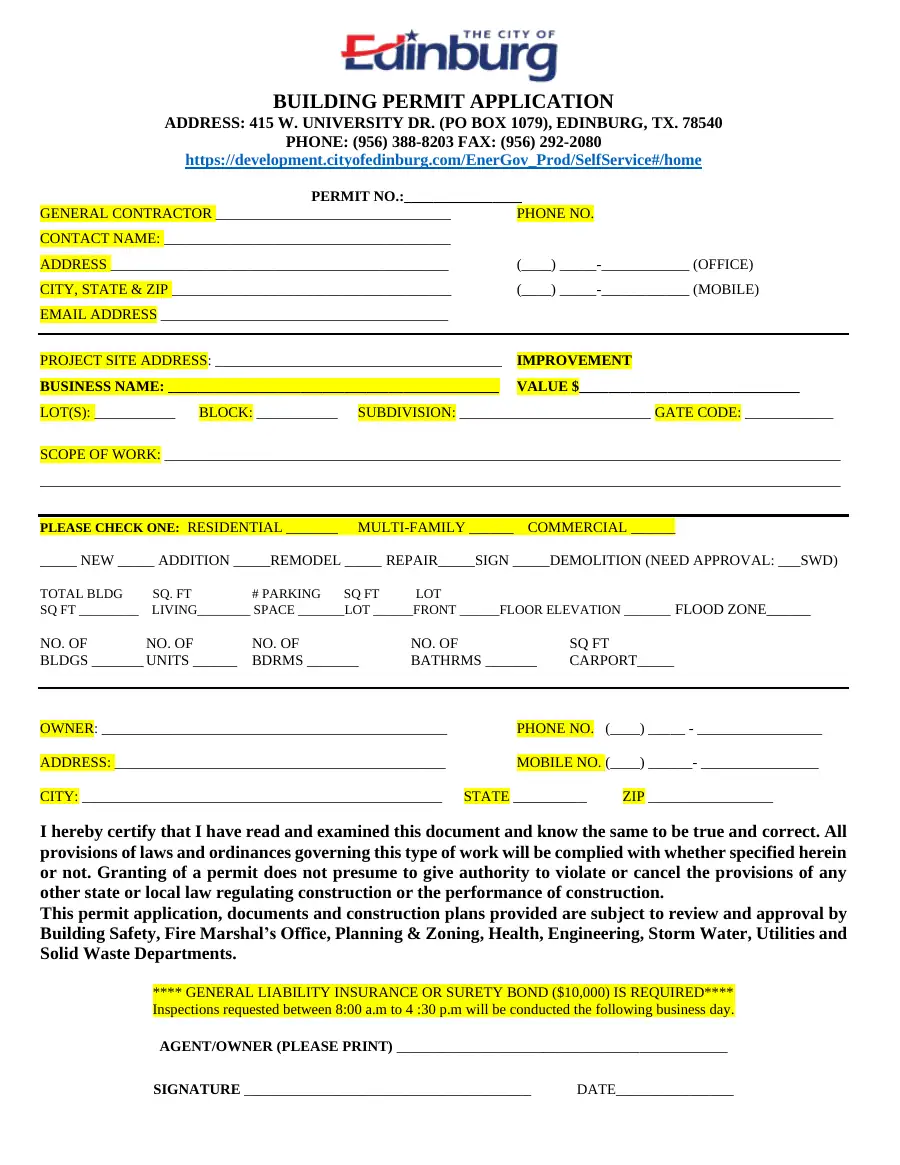
Edinburg's own permit form, filled in for you, $49.99: answer the quiz and we type your answers onto the city's form.
★★★★★ 4.8 from 6 customer reviews: “In a world of ever-increasing slop, it's nice to have a tool that cuts through all the low-quality sites, promoted on regular search engines, to get to the actual government forms.” (Kollin P.) “I got exactly what I needed in less than a minute, hassle free and painless” (Michael W.) All reviews
Prefer to file it yourself? The $24.99 Filing Kit gives you the answer for your address, what Edinburg needs from you and step-by-step instructions. Check my Edinburg address →
Do I need a permit in Edinburg, Texas?
Edinburg sits in the heart of the Rio Grande Valley, where heat, humidity, and expansive clay soils shape every building decision. The City of Edinburg Building Department enforces the 2015 International Building Code with Texas amendments — the same code adopted statewide, but Edinburg's local zoning and floodplain rules add a layer of complexity most homeowners don't expect. The Valley's shallow frost depth (6 to 18 inches in most of Edinburg proper, deeper west toward the panhandle) means deck footings, fence posts, and foundation work sit in a different world than northern climates. Add Houston Black clay — the kind that swells in wet seasons and shrinks in dry ones — and you've got soil conditions that building inspectors watch closely. Most homeowners in Edinburg need a permit for decks, additions, pools, fences over 6 feet, and any electrical or plumbing work. Some projects — minor repairs, single-story detached sheds under certain square footage, and fence work in specific conditions — may be exempt. The safe move is a quick call to the Building Department before you break ground. Owner-builders are allowed on owner-occupied residential property, but you'll still file for permits in your name and pull any required subpermits (electrical, plumbing, mechanical) yourself or through a licensed contractor.
What's specific to Edinburg permits
Edinburg's clay soils are the first thing inspectors think about. The expansive Houston Black clay common throughout the Valley can cause foundation movement and drainage problems if footings, grading, and moisture barriers aren't handled right. When you file for a deck, addition, or pool, expect the inspector to ask about your soil conditions and grading plan — especially if your lot has drainage issues or sits low relative to neighbors. Some inspectors will require a soil report for additions; others will spot-check during footing inspection. If your lot has caliche (the white, rock-hard layer common west of Edinburg), post holes and footings may hit it, and you'll need to work around it or break through — plan for that cost in your fence or deck budget.
Edinburg is in FEMA flood zones for parts of the city; others sit outside. If your address is in a Special Flood Hazard Area (Zone A or AE), flood-resistant construction rules kick in — elevated foundations, materials that resist water damage, proper grading. The Building Department can tell you your flood zone in seconds; many permit applications ask about it up front. If you're near the 100-year floodplain, inspectors will flag it, and you may need additional elevation or engineering. Check the FEMA flood map for your address before you design a deck or foundation work.
The 2015 International Building Code with Texas amendments is Edinburg's baseline, but the city enforces local amendments for setbacks, height limits, lot coverage, and parking. Residential zoning in Edinburg typically allows single-family homes on lots as small as 5,000 to 7,500 square feet (verify in your deed or with the Planning Department), and setback rules for additions and accessory structures vary by zone. When you file for a deck or fence, the inspector will want to confirm it's not encroaching on a utility easement, not blocking required sight lines (especially on corner lots), and not violating the setback. Lot lines are your responsibility to know — if you file with wrong setback measurements, the permit gets rejected, and you'll be back at the counter with a revised site plan.
Inspections in Edinburg run on the typical schedule: footing (before you pour concrete), framing (rough-ins for electrical and plumbing visible), and final. For decks, that's often footings, framing, and final. For additions, it's footings, framing, mechanical/electrical/plumbing rough-in, drywall (sometimes), and final. Plan for 1 to 3 weeks between permit issuance and your first inspection — longer if the department is backed up or if plan review uncovers issues. Many inspectors in Edinburg will do same-day or next-day inspections if you call ahead; others book 3 to 5 days out. Ask when you pick up your permit.
The Building Department processes most residential permits over-the-counter at City Hall. Online portals exist for some transactions, but in-person filing is still standard for new permits. Hours are typically Monday through Friday, 8 AM to 5 PM; call ahead to confirm and to ask if your specific project can be submitted electronically or if you need to walk in with originals. The department is closed on holidays and sometimes announces weather closures in summer heat or during Valley rain events, so plan your filing date with a buffer.
Most common Edinburg permit projects
These projects are the bread and butter of Edinburg residential permits. All require a building permit under most conditions. Click each to see local thresholds, code sections, fees, and what inspectors focus on.
Decks
Most decks over 30 inches high or over 200 square feet need a permit. Edinburg's 6- to 18-inch frost depth means footing depth is shallower than northern code but still a main inspection point. Pool decks and enclosed decks have stricter rules.
Fences
Fences over 6 feet (side or rear) or over 4 feet (front) usually need a permit. Corner-lot sight-triangle rules apply. Clay soils and post-heave in wet seasons mean proper footing depth and drainage matter more in the Valley.
Electrical work
New circuits, subpanel upgrades, service upgrades, and major appliance installations typically need an electrical permit. Licensed electricians usually pull these; owner-builders can file them. NEC 2017 applies (Texas adoption). Plan-check time is usually 1 to 2 weeks.
Room additions
Any addition to a house requires a full building permit, plan review, and multiple inspections. Soil and foundation type, electrical upgrades, and plumbing tie-ins are all reviewed. Plan 4 to 8 weeks for permit processing and construction.
Edinburg Building Department contact
City of Edinburg Building Department
Monday–Friday, 8 AM–5 PM
For the phone number and current details, see the city's official website.
Texas context for Edinburg permits
Texas adopts the International Building Code on a statewide basis but allows each municipality to amend it. Edinburg uses the 2015 IBC with local amendments. Importantly, Texas does not have a statewide residential electrical code adoption — the city follows the 2017 National Electrical Code (NEC). Plumbing follows the 2015 IPC (International Plumbing Code) as adopted by the state. Owner-builders are allowed on owner-occupied single-family homes in Texas; you can pull your own permits and do the work yourself, but you must obtain the permits in your name and pass all required inspections. Licensed contractors are required for certain trades (electrical, plumbing, HVAC) in some cities, but Texas law allows owner-builders to do their own work on their own property — check with Edinburg on whether they require licensed electricians for service upgrades or only for commercial work. Propane pools, hot tubs, and gas lines may fall under HVAC or mechanical scope and may require a licensed contractor; ask the Building Department. Texas has no state-level floodplain rule beyond FEMA compliance, so Edinburg's local floodplain ordinance is your rule. The Valley sits outside hurricane zones but does experience tropical storms and heavy rain; drainage and grading get inspector scrutiny, especially in flood zones.
Common questions
Do I need a permit for a small shed in my backyard?
Usually yes, unless it's under a certain square footage and not used for living space. Most jurisdictions in Texas exempt detached structures under 120 to 200 square feet if they're not attached to the main house and not used for habitation. But setback rules still apply — the shed usually has to be a certain distance from property lines and easements. Edinburg may have a different threshold. Call the Building Department and describe your shed: size, location on the lot, whether it has utilities. They'll tell you in two minutes whether you need a permit.
What's the difference between a pergola and a covered patio that needs a permit?
A pergola with an open lattice roof usually doesn't block rain and isn't considered an enclosed structure, so it may be exempt from permitting if it's under a certain square footage and height. A covered patio with a solid roof or partial enclosure (screens, walls, etc.) is a structure and typically requires a permit if it's over 200 square feet, attached to the house, or over 30 inches high. The distinction depends on how much roof coverage you have. Fully enclosed patios are additions and need full permits. Ask the Building Department to clarify based on your design before you order materials.
How much does a residential building permit cost in Edinburg?
Permit fees in Texas cities vary widely. Most residential permits run 1% to 3% of the project's estimated cost. A $10,000 deck might cost $100 to $300 for a permit; a $50,000 addition might cost $500 to $1,500. Edinburg's fee schedule is set by city ordinance and includes plan-review fees, inspection fees, and sometimes a base application fee. Call or visit the Building Department to get the exact fee schedule — it's usually a one-page table. Fees often are refundable if the permit expires unused; ask about expiration (typically 180 days for residential).
What happens if I build without a permit?
The inspector or a neighbor can report unpermitted work. The city then issues a Stop Work order, and you have to halt construction. You'll be cited, fined (often $100 to $300 per day), and required to obtain a retroactive permit and have the work inspected. Unpermitted work can fail inspection, requiring costly rework. If you sell the house, a title company or buyer's inspector may flag unpermitted additions, and you'll have to either permit and inspect the work retroactively or remove it — much harder and more expensive after the fact. Insurance may also deny claims on unpermitted structures. The few hundred dollars saved by skipping a permit usually costs thousands later.
Can I pull my own electrical or plumbing permits as the homeowner?
Yes, if you're the owner-builder on owner-occupied property in Texas. You can pull electrical and plumbing permits in your name and do the work yourself, though you'll need to pass inspections. Some cities require that the work be performed by a licensed contractor, so ask Edinburg upfront: call and ask if owner-builders can do their own electrical work or if a licensed electrician must pull and perform the work. For service upgrades (panel work, main breaker changes), many inspectors prefer or require a licensed electrician even if owner-builders are allowed to do circuit work. Plumbing is similar — fixture work and simple drain extensions are often owner-builder-eligible, but vent restacks and main line work sometimes require a licensed plumber. Ask first; it saves a rejected inspection.
How long does plan review take in Edinburg?
Most residential permits are routed through over-the-counter review and issue same-day or next business day if they're complete. Additions and major projects go to a plan reviewer and typically take 1 to 3 weeks, depending on the department's workload. If the reviewer finds issues (wrong setbacks, missing soil report, unclear electrical layout), you'll get comments and have to resubmit. That can add another 1 to 2 weeks. Budget 4 to 6 weeks for a complete addition permit, including any resubmittals. Call the department and ask current turnaround time — they'll tell you if they're backed up.
Does Edinburg require a soil report for foundations or additions?
Texas doesn't mandate soil reports for all residential work, but inspectors in areas with expansive clay (like Edinburg) may require them for additions or foundation work if soil conditions are a concern. The Houston Black clay in much of the Edinburg area can cause settlement and movement if not handled properly. Some inspectors will ask for one upfront; others will spot-check during footing inspection and may request one if they see risk. If you're adding a room or doing major foundation work, contact a local geotechnical engineer or ask your Building Department whether a soil report is required. It costs $300 to $800 but can save expensive rework later.
What's the frost depth for footings in Edinburg?
Edinburg's frost depth is typically 6 to 18 inches, much shallower than northern climates. This affects deck footings, fence posts, and foundation work. The 2015 IRC (which Edinburg adopts) requires footings to be below the frost line, so in Edinburg that's often 12 to 18 inches below finished grade. West toward the panhandle, frost depth can reach 24 inches or more, so verify your specific location. Ask the inspector or Building Department for your area's frost depth when you design your footing depth. It's a quick call that saves digging in the wrong place.
Do I need a permit for a fence repair or replacement?
Usually no, if you're replacing an existing fence in-kind — same height, same style, same location. But if you're rebuilding it taller, moving it, or replacing it with a different type, you may need a permit. Also, if the original fence didn't have a permit (old or unpermitted), the city may require a new permit when you rebuild. Call the Building Department and describe the work: are you just replacing rotted posts and boards, or are you raising the height? That determines if you need a permit. If in doubt, pull one — it's cheaper than a Stop Work order.
Ready to file your Edinburg permit?
Start with a call or visit to the City of Edinburg Building Department. Have your address, the type of project, and a rough estimate of size and cost ready. Most departments can tell you in minutes whether a permit is needed and what the fee and timeline will be. If your project is complex — an addition, a pool, anything in a flood zone — bring a simple sketch showing your lot and the structure's location. The Building Department's feedback in that first conversation saves weeks of back-and-forth later. Once you know you need a permit, file in person at City Hall or through the online portal if the city offers one. Keep your permit visible on-site during construction, and schedule inspections as work progresses. Questions after you've filed? The inspector assigned to your permit is your best resource — they'll walk you through what they're looking for and what's likely to pass.
More Texas towns
Towns near Edinburg in the alphabet where we file your permit for you: Caldwell, Conroe, Daingerfield, Decatur, El Paso, Ennis, Farmers Branch, Farmersville.