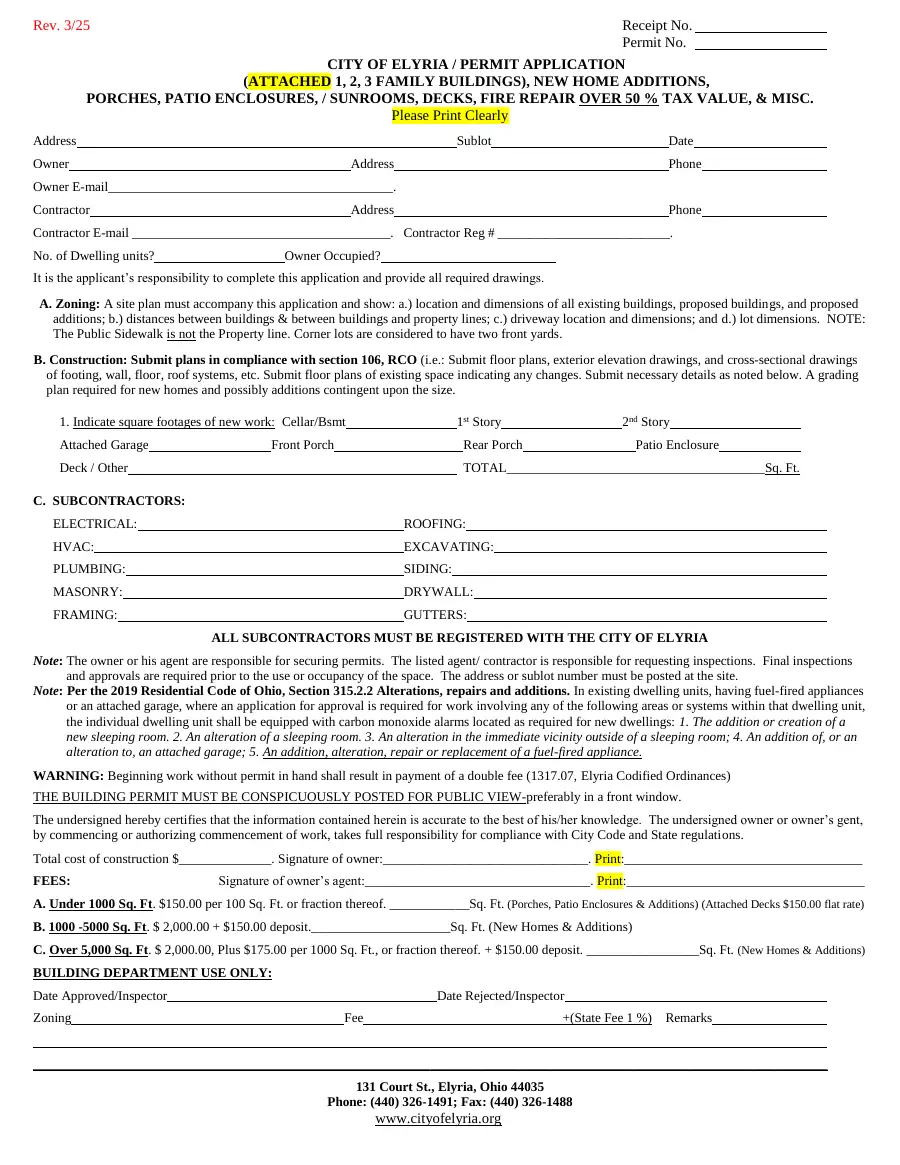
Elyria's own permit form, filled in for you, $49.99: answer the quiz and we type your answers onto the city's form.
★★★★★ 4.8 from 6 customer reviews: “In a world of ever-increasing slop, it's nice to have a tool that cuts through all the low-quality sites, promoted on regular search engines, to get to the actual government forms.” (Kollin P.) “I got exactly what I needed in less than a minute, hassle free and painless” (Michael W.) All reviews
Prefer to file it yourself? The $24.99 Filing Kit gives you the answer for your address, what Elyria needs from you and step-by-step instructions. Check my Elyria address →
Do I need a permit in Elyria, Ohio?
Elyria sits in Ohio's climate zone 5A with a 32-inch frost depth — colder than most of the state, which shapes deck footings, foundation work, and winter construction schedules. The City of Elyria Building Department administers permits for residential work, enforcing the Ohio Building Code (which adopts the 2017 International Building Code with state amendments). Most residential projects — decks, additions, roofing, electrical work, HVAC — require a permit before work starts. The good news: Elyria allows owner-builders to pull permits on their own owner-occupied homes, which saves contractor licensing fees. The harder part is knowing which projects actually trigger the requirement. A water-heater swap doesn't. A finished basement with egress windows does. A small shed might not. A deck almost always will. This page walks you through Elyria's actual rules, common rejection reasons, typical fees, and where to file.
What's specific to Elyria permits
Elyria's 32-inch frost depth is the governing constraint for any project involving the ground. Decks, porches, fences, sheds, footings for walls — they all need to rest on footings that extend below 32 inches to avoid frost heave. This is 4 inches deeper than the base IRC minimum, which means local inspectors will reject footing sketches that don't account for the extra depth. When you're planning a deck or pole-barn foundation, assume 36 inches minimum from finished grade; frozen ground that expands can lift a 12×16 deck two inches off its posts by March. The clay and sandstone soils east of Elyria also affect drainage — perimeter footings sometimes need extra detail around water management. Bring soil conditions up with the Building Department if you're doing foundation work.
Ohio adopted the 2017 IBC with state amendments, and Elyria enforces that edition. The state has no statewide electrical license requirement for homeowners doing their own work on owner-occupied property — but Elyria's local inspector still needs to sign off on any circuit additions, HVAC wiring, or rough-in work before drywall closes. This is not optional, and failing inspection can mean ripping out finished walls to fix buried work. If you're doing electrical, file early and budget for at least one rough-in inspection before insulation goes in.
The City of Elyria Building Department processes most permits in person at City Hall. As of this writing, Elyria does not operate a fully functional online permit portal — you'll walk in or call to file. This is both a constraint and an advantage: you can get real-time feedback from the permit technician, ask clarifying questions, and potentially grab a permit the same day for simple projects (like a fence or small shed). Plan for a 30-minute visit if you're new; bring photos, a site plan showing property lines and setbacks, and a project scope (square footage, materials, scope of work). Inspections are scheduled by phone after filing.
Elyria's most common rejection reasons are missing setback documentation (especially on corner lots), inadequate frost-depth detail on footing sketches, and vague electrical scopes. Setbacks are the #1 culprit: lot lines sometimes aren't where homeowners think they are. If you're within 10 feet of a property line, the Building Department will ask for a survey or a certified fence layout. Don't guess. Second most common: submitting a deck plan without a detail showing 36-inch footing depth — the inspector will ask you to redraw it. Third: filing an electrical permit that just says 'new outlets' without specifying breaker size, wire gauge, and location. A 5-minute phone call to the Building Department before filing often heads off these rejections.
Winter construction is common in Elyria, but frost-depth inspections happen year-round. If you're building in January or February, expect a 2-3 week wait for a footing inspection because the inspector needs to verify that the frost line is below the footing — difficult or impossible in frozen ground. Plan major foundation or deck work for April through October if you're on a tight timeline. The Building Department will not approve a footing inspection if the ground is frozen solid, even if you have frost-protected shallow foundation (FPSF) design — they want to see daylight soil.
Most common Elyria permit projects
These projects trigger Elyria's permit requirement and come across the Building Department desk most frequently. Each has its own quirks specific to Ohio code, frost depth, and local enforcement.
Decks
Nearly every elevated deck in Elyria requires a permit. Frost depth is 32 inches, so footings must extend at least 36 inches below finished grade. Attached decks also trigger roof load calculations and ledger-board flashing detail.
Fences
Residential fences over 6 feet and all corner-lot fences require permits. Footing depth must account for Elyria's 32-inch frost line. Most fences in interior side or rear yards under 6 feet are exempt.
Roof replacement
Roof replacement requires a permit and structural review if the existing roof has damage or if you're changing materials (asphalt to metal, for example). Elyria inspectors check decking, ventilation, and flashing detail — common failure: inadequate soffit venting.
Electrical work
Any new circuit, subpanel, or major HVAC wiring needs an electrical permit and inspection. Owner-builders can pull the permit themselves in Elyria. Budget for rough-in inspection before drywall and final inspection after trim-out.
HVAC
Installation of a new furnace, AC, or heat pump requires a permit and mechanical inspection. Elyria inspects ductwork sizing, venting, and gas-line installation (if applicable). If you're replacing a unit in-place with the same fuel, some jurisdictions waive the permit — call first.
Room additions
Any room addition needs a permit for foundation, framing, electrical, HVAC, and roofing. Elyria's frost depth of 32 inches applies to all new footings. Plan for plan review (2-4 weeks) plus foundation, rough framing, electrical, and final inspections.
Basement finishing
A finished basement always requires a permit if it involves walls, egress windows, electrical circuits, or HVAC changes. Ohio code requires egress windows or a door for any bedroom in a basement. Elyria inspectors check window dimensions, sill height, and barrier-free route compliance.
Elyria Building Department contact
City of Elyria Building Department
Monday–Friday, 8 AM–5 PM
For the phone number and current details, see the city's official website.
Ohio context for Elyria permits
Ohio adopted the 2017 International Building Code as its base standard, with state-specific amendments. The state does not require a residential contractor license for owner-builders working on their own occupied homes — Elyria allows this under state law. However, any licensed trade work (electrical, plumbing, HVAC by a contractor) requires that contractor to be licensed and bonded. As an owner-builder, you can do your own electrical and plumbing on owner-occupied property, but the local inspector (Elyria's) must approve the work before it's covered. Ohio also does not mandate a statewide energy code beyond what's in the 2017 IBC, so Elyria enforces baseline IBC requirements for insulation, air sealing, and window performance. Winter construction is routine in Ohio, but frost-depth inspections become harder (sometimes impossible) in January–March when the ground is frozen. Plan major footing work for April–October if possible.
Common questions
Do I need a permit for a deck in Elyria?
Yes, almost all attached decks and any elevated deck require a permit. The exception is very small platforms (under 30 inches high, under 200 square feet, not providing primary exit) — but even then, most inspectors want to see the plan. Elyria's 32-inch frost depth means your footings must extend at least 36 inches below finished grade. File the permit with a footing detail showing depth, post size, and concrete volume. Budget $150–$400 for the permit fee (typically 1.5–2% of estimated cost, with a $100 minimum). Expect plan review in 1–2 weeks and footing inspection within 5 days of filing, then framing inspection after structure goes up.
What's the frost depth in Elyria and why does it matter?
Elyria is in climate zone 5A with a 32-inch frost depth. This is the depth below which the ground does not freeze in an average winter. Any post, piling, or footing sitting above this line can heave (lift) when water in the soil freezes and expands. A deck sitting on footings 24 inches deep could rise 2–3 inches by March, then settle unevenly as it thaws — cracking ledger boards, pulling posts apart, and creating tripping hazards. Elyria's inspectors require footings to bottom out at least 36 inches to account for site variability. When you submit a deck, fence, or shed plan, include a footing detail with the depth clearly marked. This is the #1 thing that gets plans bounced back.
Can I file a permit online in Elyria?
As of this writing, no. Elyria processes permits in person at City Hall or by phone. Bring or mail photos, a site plan showing property lines and setbacks, and a project description. The advantage: you can talk to the permit technician, ask clarifying questions, and sometimes walk out with a permit the same day for simple projects (like a fence or small shed). The constraint: you can't file at 11 PM on a Sunday. Plan to visit during business hours (Monday–Friday, 8 AM–5 PM). Call ahead to confirm hours and current procedures.
Do I need a contractor's license to do my own work in Elyria?
No — Ohio allows owner-builders to pull permits and do the work themselves on owner-occupied homes. You do not need a residential contractor license. However, any licensed trade work (electrician, plumber, HVAC technician) performed by a contractor must be done by someone licensed in Ohio. If you're doing electrical or plumbing yourself, you can — but the local inspector must approve the work. This is not optional. Budget time for rough-in and final inspections.
What's the biggest reason permits get rejected in Elyria?
Missing or wrong setback information. Lot lines are not always where homeowners think they are. If your project (especially a fence, shed, or addition) sits within 10 feet of a property line, the Building Department will ask for proof of setback — either a professional survey or a certified layout from a fence company. Corner lots get extra scrutiny because sight-triangle setbacks are stricter. Second most common: footing details that don't show 36-inch depth. Third: electrical scopes that say 'new outlets' without specifying breaker size, wire type, or exact location. A 5-minute call to the Building Department before filing saves a trip back.
How much do permits cost in Elyria?
Permit fees vary by project type and value. Most residential permits run 1.5–2% of the estimated project cost, with a typical floor of $100–$150. A $10,000 deck might cost $200–$250 to permit. A $50,000 addition might be $750–$1,200. Electrical subpermits are often flat fees ($75–$150). Fence permits typically run $75–$150 flat. Ask for the fee schedule when you file — Elyria should provide it. Some cities charge extra for plan review or reinspection if work fails; ask whether reinspection is free or $50–$100 per try.
When is the best time of year to build in Elyria?
April through October is ideal. Winter (January–March) is possible, but footing and foundation inspections are harder because inspectors can't verify the frost line in frozen ground. Snow and ice also slow inspections and material delivery. Fall (September–October) is excellent because the ground is dry and frost-depth inspection is straightforward. Spring (April–June) is busy and plan-review queues can stretch 3–4 weeks. If you have flexibility, build May–September to avoid winter delays and spring backlogs.
Do I need a permit for a finished basement in Elyria?
Yes. Any finished basement requires a permit if it involves walls, flooring, electrical, HVAC, plumbing, or an egress window. Ohio code requires an egress window or door for any bedroom in a basement. The window must be at least 32 inches wide, 48 inches tall, and the sill height cannot be more than 44 inches above the interior floor. Most basements also need GFCI outlets and smoke detection. File the permit with floor plans showing window location, sill height, and interior finish materials. Budget for rough-in inspection (after framing and electrical, before drywall), then final inspection after trim.
Can I do electrical work myself in Elyria?
Yes, if it's owner-occupied property and you're the owner. You must pull an electrical permit and the local inspector must approve the work. Ohio does not require a homeowner's electrician license. However, any licensed electrician you hire must be licensed in Ohio. File the electrical permit with a scope sheet showing the new circuit(s), breaker size, wire type and gauge, and exact location (e.g., 'new 20-amp circuit from main panel to kitchen island, 12-gauge Romex'). Budget for rough-in inspection before drywall and final inspection after trim-out. Most rough-in inspections happen within 5 days of filing.
Ready to file?
Call or visit the City of Elyria Building Department before you start work. Confirm the current phone number and hours by searching 'Elyria OH building permit phone' or calling City Hall. Have your site plan, project photos, and a description of the work ready. If you're uncertain whether your project needs a permit, ask — a 90-second phone call beats an expensive correction later. For specific projects, use the links above to see detailed checklists, inspection sequences, and common rejection reasons.
More Ohio towns
Towns near Elyria in the alphabet where we file your permit for you: Cincinnati, Cleveland, Colerain, Dublin, Fairfield, Fairport Harbor, Forest Park, Franklin.