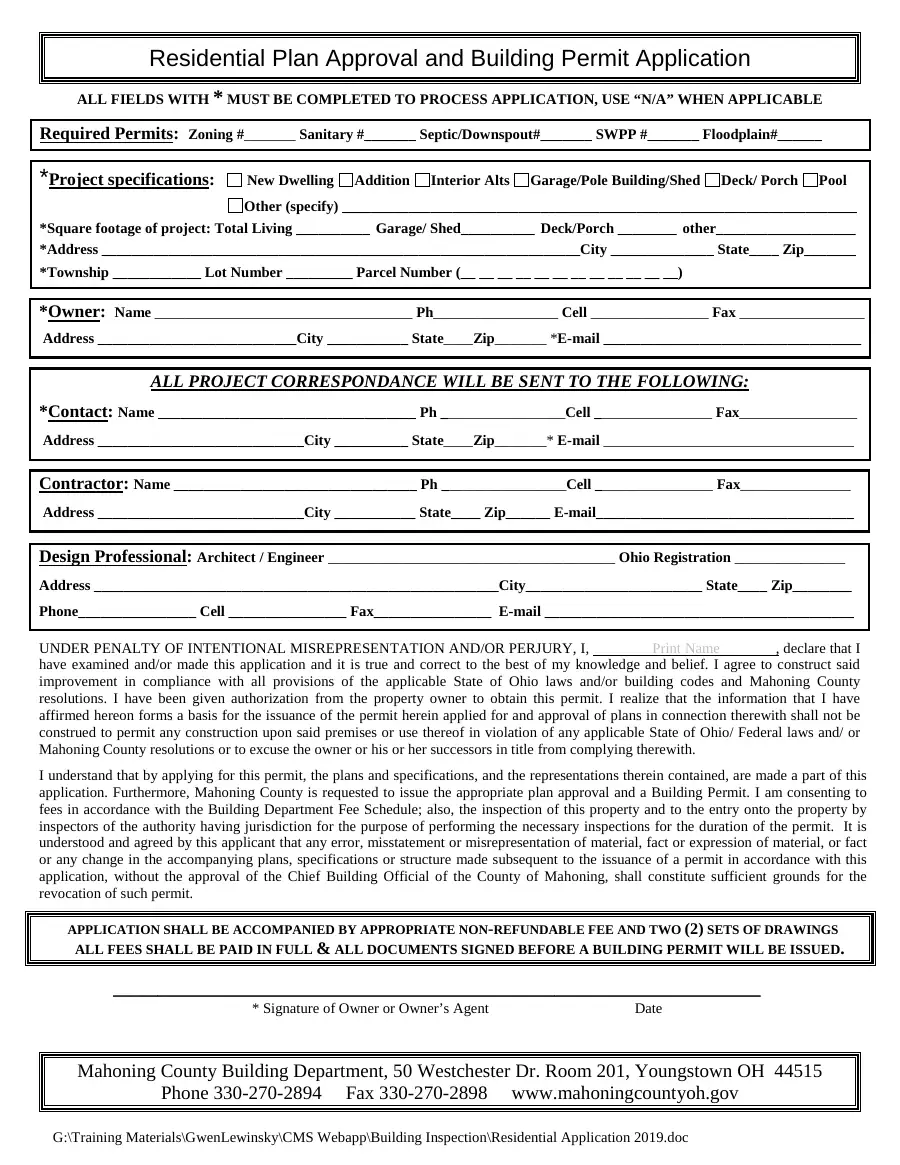
Youngstown's own permit form, filled in for you, $49.99: answer the quiz and we type your answers onto the city's form.
★★★★★ 4.8 from 6 customer reviews: “In a world of ever-increasing slop, it's nice to have a tool that cuts through all the low-quality sites, promoted on regular search engines, to get to the actual government forms.” (Kollin P.) “I got exactly what I needed in less than a minute, hassle free and painless” (Michael W.) All reviews
Prefer to file it yourself? The $24.99 Filing Kit gives you the answer for your address, what Youngstown needs from you and step-by-step instructions. Check my Youngstown address →
Youngstown's own permit form, filled in for you, $49.99: answer the quiz and we type your answers onto the city's form.
Prefer to file it yourself? The $24.99 Filing Kit gives you the answer for your address, what Youngstown needs from you and step-by-step instructions. Check my Youngstown address →
Youngstown Building Department contact
City of Youngstown Building Department
Monday–Friday, 8 AM–5 PM
For the phone number and current details, see the city's official website.
Ohio context for Youngstown permits
Ohio adopts the International Building Code (IBC) with state amendments. Youngstown sits in IECC climate zone 5A, which affects insulation requirements, window ratings, and foundation design — particularly frost depth. The state allows owner-builders on owner-occupied residential property to pull permits and perform work without a general contractor license, a significant advantage for homeowner DIY projects. However, electrical work has restrictions: an owner-builder can do electrical work on their own home, but it must be inspected and approved by the local authority having jurisdiction (in this case, Youngstown). Service-panel upgrades and some high-risk circuits may require a licensed electrician — check with the building department. Plumbing by owner-builders is similarly permitted on owner-occupied homes, but must pass inspection. Gas work (furnace, water heater, stove) almost always requires a licensed gas fitter. Ohio's state fire code and energy code are enforced locally, so expect inspectors to verify GFCI protection in wet areas, proper ventilation, egress windows in bedrooms, and insulation to code. Homeowners coming from states with lighter code enforcement are often surprised by Ohio's rigor — that's actually a strength. It means the city cares about safety and durability.
Common questions
Do I need a permit for a small shed in my backyard in Youngstown?
Sheds under 120 square feet are often exempt from permit requirements in Ohio, but zoning setback and lot-coverage rules still apply. If your shed is over 120 square feet, or if your lot is in a flood zone or has other restrictions, you need a permit. The safest move is a 5-minute call to the building department before you buy materials. Even if the shed is exempt from a building permit, you may need a zoning clearance, which counts as a separate filing.
How deep do deck footings need to be in Youngstown?
Youngstown's frost depth is 32 inches, which means deck footings and posts must be buried at least 32 inches below grade. This is a code requirement — not a suggestion. If you go down only 24 or 30 inches, the post will heave during winter freeze-thaw cycles and your deck will be unsafe within a year or two. Budget for deeper holes and more concrete. The building inspector will verify footing depth during the foundation inspection.
Can I do electrical work myself on my own home in Youngstown?
Ohio law allows owner-builders to do electrical work on owner-occupied residential property, but it must be inspected and approved by the building department. Simple work like adding a GFCI outlet or replacing a light fixture may not need a permit, but any new branch circuit, panel upgrade, or permanent installation does. Call the building department before starting — they'll tell you what needs a permit and what doesn't. Some jurisdictions require a licensed electrician for service-panel upgrades or 240-volt work; Youngstown's rules may vary.
How long does a typical Youngstown building permit take?
Simple permits like a basic fence or small shed can be issued over-the-counter same-day. Complex projects like additions, roof replacements, or basement finishes go into plan review, which typically takes 2–3 weeks. The clock resets if the building department has comments — you revise and resubmit, and review restarts. Over-the-counter permits bypass plan review entirely. Ask the building department which category your project falls into before you file.
What happens if I skip the permit on a deck or addition in Youngstown?
Skipping a permit is risky. If a future buyer or insurance company discovers unpermitted work, the property can be marked defective and you may be ordered to tear it down. Lenders sometimes refuse to finance homes with unpermitted additions. Fines can range from $100 to $500 per day of non-compliance. More important: unpermitted work doesn't get inspected, so it may not meet code and could be unsafe or fail during a storm. Get the permit. The cost and time investment is a fraction of the cost of fixing it later.
Do I need a permit to replace my water heater or furnace in Youngstown?
Yes. Water heater and furnace replacement require a permit and inspection. The building department verifies proper venting, gas or electrical hookup, combustion air, and safety controls per code. Many homeowners skip this, but if an inspector finds an unpermitted unit during a future renovation inspection or insurance audit, you can be fined and ordered to bring it into compliance. The permit cost is $50–$150; the cost of fixing an improper installation can be $500–$2,000. File the permit.
What's the frost depth in Youngstown and why does it matter?
Youngstown sits in IECC climate zone 5A with a 32-inch frost depth. This is the depth below grade where soil temperature stays above freezing year-round. Any footing, foundation, deck post, fence post, or shed pier that doesn't go past 32 inches will experience frost heave — the soil freezes, expands, and pushes the structure up. Come spring thaw, it settles unevenly and cracks or fails. This is why Youngstown inspectors are strict about footing depth. Budget for deeper holes and more concrete than you might in a warmer climate.
How much does a building permit cost in Youngstown?
Permit fees vary by project type and valuation. A simple fence permit might be $50–$100; a deck $200–$400; a room addition $300–$800. Most jurisdictions in Ohio base fees on estimated project cost — typically 1–2% of valuation. Inspections are bundled into the permit fee; there are no surprise charges. Call the building department with your project scope and they'll give you a fee estimate.
Ready to file your Youngstown permit?
Start with a call or visit to the City of Youngstown Building Department. Have your project details ready — lot address, project scope, square footage, and basic drawings or photos. They'll tell you what you need, what the fee is, and how long review takes. If your project is complex, consider hiring an engineer or architect to draw plans — it costs more upfront but speeds up review and cuts rejections. For most residential projects, the building department staff can walk you through the filing process same-day. Don't skip the permit. The cost to file is a small fraction of the cost to fix code violations or tear down unpermitted work later.
More Ohio towns
Towns near Youngstown in the alphabet where we file your permit for you: Adams County, Amherst, Ashtabula, Aurora, Avon Lake, Berea, Bexley, Blue Ash.